Custom Metal Stamping Materials and Finishes: Types, Properties, and How to Choose
Choosing the right material and surface finish is one of the most important decisions in custom metal stamping. The material affects how a part can be formed, how much load it can withstand, how well it resists corrosion, and how reliably it performs in its final application. The surface finish adds another layer of performance by influencing appearance, conductivity, wear resistance, and environmental protection.
For OEM buyers and product engineers, the best choice is not necessarily the strongest or most expensive metal. It is the combination of material, stamping process, and surface treatment that meets the part's functional requirements while keeping production practical and cost-effective.
Jiaxin (Xiamen) Precise Metal Co., Ltd. (JX Precise) manufactures customized precision metal stamping components for automotive systems, electrical equipment, consumer electronics, industrial applications, and other sectors. This guide explains the common materials and finishes used in custom metal stamping, compares their properties, and provides a practical framework for selecting the right combination for your project.
Metal stamping uses dies and presses to cut, bend, draw, or form sheet metal into specific shapes. During production, the selected material must withstand the required forming operations without excessive cracking, wrinkling, deformation, or dimensional variation.
However, successful forming is only one part of the requirement. Once manufactured, a stamped component must perform in its intended working environment. An electrical terminal needs reliable conductivity and contact performance. An automotive bracket may need mechanical strength and corrosion protection. A motor cover may require dimensional stability, heat management, and a consistent exterior finish.
Material and finish selection directly influence several important factors:
A suitable combination helps reduce manufacturing defects, unnecessary processing, and long-term performance problems. For buyers developing a new component, it is useful to discuss material selection and surface treatment with the stamping manufacturer before finalizing the design.
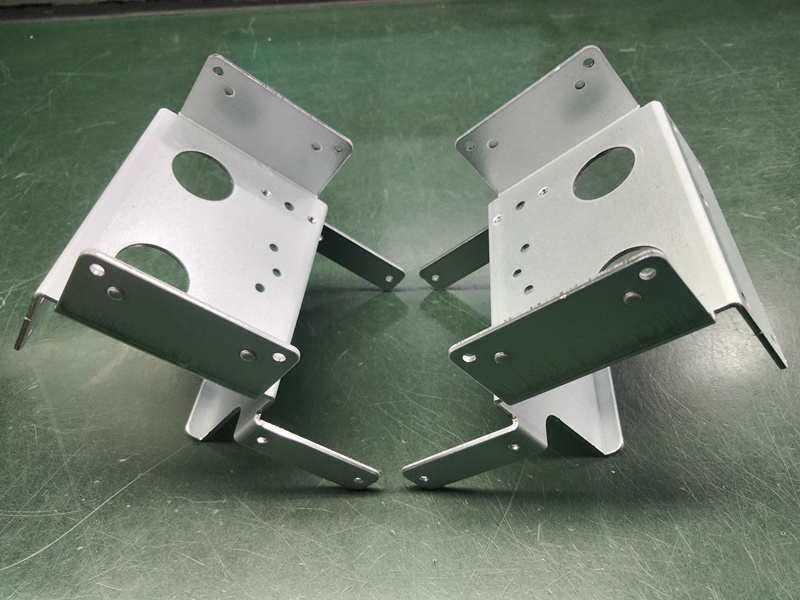
Precision stamped metal support frames for industrial equipment applications.
Different metals offer different combinations of strength, conductivity, corrosion resistance, weight, and formability. The following materials are commonly considered when developing precision stamped components.
Cold-Rolled Steel
Cold-rolled steel, including grades such as SPCC and DC01, is widely used for general-purpose metal stamping. It offers a smooth surface, consistent thickness, and good dimensional control, making it suitable for components that require accurate cutting and forming.
Typical applications include brackets, support frames, equipment fittings, and automotive hardware. Cold-rolled steel is often selected when buyers need a balance between mechanical performance, forming characteristics, and material cost.
Its main limitation is that untreated carbon steel can be vulnerable to corrosion in humid or exposed environments. Plating, painting, or another protective finish may therefore be necessary depending on the application.
Galvanized Steel
Galvanized steel has a zinc coating that helps protect the underlying steel from corrosion. Common material designations include SGCC and SECC, although their coating processes and characteristics differ.
SGCC hot-dip galvanized steel is often used for brackets, support structures, electrical enclosures, and equipment accessories that need additional corrosion protection. SECC electro-galvanized steel may be considered for indoor electrical and electronic components where surface appearance and processing requirements are important.
Buyers should confirm the coating specification, thickness, forming requirements, and exposed-edge conditions before selecting galvanized sheet for a stamped component.
JX Precise manufactures customized SGCC Steel Metal Stamping Support Frames, using hot-dip galvanized sheet and stamping processes including blanking, bending, and tapping.
Stainless Steel
Stainless steel is selected when corrosion resistance, strength, surface appearance, or durability is important. Common grades used in stamped components include SUS201, SUS301, SUS304, SUS316, and SUS430. Their properties differ, so the grade should be matched to the working environment and forming requirements.
Stainless steel is commonly used in bathroom hardware, appliance components, automotive fittings, and electrical accessories. JX Precise provides customized Stainless Steel Panel Hardware Stamping Parts, with product examples made from SUS201 and processed through stamping and subsequent surface treatment.

Stainless steel stamped panels with formed openings and shaped edges.
Aluminum Alloys
Aluminum alloys are attractive for applications where low weight, corrosion resistance, and thermal conductivity are important. Common options include 5052 and 6061, although their forming behavior and mechanical characteristics are different.
5052 aluminum offers good corrosion resistance and formability, making it suitable for sheet metal components, enclosures, and lightweight hardware. 6061 aluminum provides higher strength in many tempers and is often used where structural performance is important, but its suitability for complex stamping and forming must be evaluated based on the selected temper and part geometry.
Aluminum is commonly considered for lightweight equipment components, electronic housings, and selected automotive applications. Anodizing or other compatible surface treatments may be used to improve surface protection and appearance.
Copper and Copper Alloys
Copper and copper alloys are particularly important for electrical and electronic stamped components because of their electrical conductivity and forming characteristics.
For electrical applications, material selection should consider not only conductivity but also contact resistance, spring force, operating temperature, and the required service life.
JX Precise manufactures customized Metal Stamping Terminals using materials such as copper alloys, brass, and stainless steel for automotive and electronic connection applications.
Silicon Steel
Silicon steel is mainly used in electromagnetic applications where magnetic performance is essential. Electrical steel grades are commonly selected for motor cores, transformer cores, and related components.
Non-oriented silicon steel is widely used in rotating electrical machines, while grain-oriented silicon steel is commonly associated with transformer core applications. The material grade, thickness, magnetic properties, and lamination design should be selected according to the equipment's electrical and operating requirements.
Silicon steel is not a general replacement for structural stamping materials. Its selection is driven primarily by magnetic performance and the design of the electrical component.
Surface finishing is used to improve a stamped part's corrosion resistance, electrical performance, wear behavior, or appearance. The correct process depends on the base material, application environment, dimensional requirements, and production budget.
Zinc Plating
Zinc plating provides a protective coating for steel components. It is commonly used for brackets, fasteners, support parts, and other hardware that needs improved corrosion resistance.
Depending on the specification, zinc plating may be combined with passivation or conversion treatments to improve corrosion performance. Buyers should define coating thickness, color, appearance, and corrosion test requirements rather than specifying zinc plating alone.
Nickel Plating
Nickel plating provides a relatively hard, wear-resistant surface and can improve corrosion protection and appearance. It is used for selected electrical terminals, connectors, and metal hardware.
For electrical contact components, the plating thickness and contact area are important. Nickel may be used as a functional finish or as an underlayer in a multi-layer plating system, depending on the required performance.
Tin Plating
Tin plating is frequently used for electrical terminals and connectors because it provides good solderability and can support reliable electrical connections when properly specified.
It is especially relevant for copper-based electrical components. The plating thickness, base material, contact conditions, and risk of tin whisker formation should be considered in applications with strict reliability requirements.
Gold and Silver Plating
Gold plating is used in selected electrical contacts where stable contact performance and resistance to surface oxidation are important. It is often specified for low-voltage signal contacts and precision connectors.
Silver plating offers very high electrical conductivity and is used in some electrical contact and power-related applications. However, silver can tarnish in certain environments, so the operating conditions and contact design need to be evaluated.
JX Precise's automotive electrical terminal product range includes copper alloys and stainless steel options, with tin-based finishes and gold or silver plating available according to customer requirements. See the High-Precision Stamped Automotive Electrical Terminals for an example of material and plating combinations.

Stamped electrical terminals in different shapes and conductive material configurations.
Passivation
Passivation is commonly applied to stainless steel to improve its corrosion resistance by removing surface contaminants and supporting the formation of a stable passive layer. It does not function in the same way as a thick metallic coating.
It is often considered for stainless steel components used in equipment, hardware, and environments where surface cleanliness and corrosion performance matter.
Anodizing
Anodizing is an electrochemical surface treatment primarily used for aluminum. It creates a controlled oxide layer that can improve surface hardness and corrosion resistance. Depending on the process, anodized aluminum can also offer different colors and surface appearances.
Anodizing is suitable for selected aluminum housings, fittings, and precision components. Designers should account for coating thickness when specifying dimensional tolerances and assembly clearances.
Powder Coating and Spray Painting
Powder coating and spray painting are commonly used to provide decorative and protective finishes for metal parts. They can offer a wide range of colors and surface textures, making them suitable for equipment covers, brackets, enclosures, and consumer-facing hardware.
These coatings should be evaluated for adhesion, thickness, impact resistance, and environmental exposure. Masking may also be required for threaded holes, electrical contact surfaces, or precision fitting areas.
Polishing and Brushed Finishes
Polishing creates a smoother and often more reflective surface, while brushing produces a directional texture. Both are used when appearance and surface consistency are important, including stainless steel bathroom hardware, appliance components, and visible metal accessories.
For components that require a specific appearance, buyers should provide a surface sample or clearly define the desired finish, direction, and acceptable visual variation.
The best material and finish combination depends on what the component needs to do. A material that works well for a structural bracket may not be the best option for an electrical terminal or a decorative appliance component.
Automotive Metal Stamping Parts
Automotive components may require mechanical strength, dimensional stability, corrosion resistance, and consistent performance under vibration and temperature changes. Cold-rolled steel, galvanized steel, stainless steel, and selected copper alloys are commonly evaluated according to the part's function.
For chassis and mounting hardware, the material and protective coating should be selected based on load, exposure, and corrosion requirements. Electrical terminals require a different approach, with conductivity, contact performance, and plating specifications taking priority.
Explore JX Precise's Automotive Metal Stamping Parts for customized components used in vehicle body, chassis, engine, and interior systems.
Electrical Terminals and Connectors
Electrical terminals need stable current transmission and dependable contact performance. Copper, brass, phosphor bronze, and selected stainless steel grades may be considered according to the required conductivity, strength, spring properties, and assembly method.
Tin, nickel, gold, or silver plating may be selected based on solderability, corrosion behavior, wear, and electrical contact requirements. The final specification should identify the contact area and performance criteria clearly.
Motor Covers and Equipment Enclosures
Motor covers and enclosures often require a combination of dimensional accuracy, structural stability, and surface protection. Cold-rolled steel and galvanized steel are common choices for many formed steel components. Aluminum may be considered where weight reduction is a priority.
JX Precise manufactures Metal Stamping Motor Covers using different forming and stamping processes, including examples made from galvanized steel for electric machinery applications.
Bathroom and Decorative Hardware
Bathroom hardware is regularly exposed to moisture, cleaning products, and frequent handling. Stainless steel is often selected for its corrosion resistance and appearance. Depending on the required design, polishing, brushing, powder coating, or other surface treatments may be applied.
For decorative components, it is important to define the expected appearance and cleaning environment as well as the base material.
When selecting a material for custom metal stamping, buyers should start with the component's actual working requirements rather than choosing a metal based only on its name or price.
Define the application and operating environment. Identify where the part will be installed, what loads it will experience, and whether it will be exposed to moisture, chemicals, heat, vibration, or electrical current.
Set the required mechanical and electrical properties. Determine the necessary strength, hardness, ductility, conductivity, spring performance, and dimensional stability. For electrical components, define current and contact requirements clearly.
Evaluate stamping complexity. Consider material thickness, bend radius, hole dimensions, drawing depth, and the number of forming operations. Complex shapes may require a material with suitable ductility and a carefully developed die design.
Choose the surface finish based on function. Specify whether the part needs corrosion protection, electrical conductivity, solderability, wear resistance, or a particular appearance. Avoid adding a finishing process that does not contribute to the component's actual requirements.
Consider total production cost. Raw material price is only one part of the cost. Tooling, scrap rate, forming difficulty, secondary operations, plating, coating, inspection, and production volume all affect the final unit cost.
Confirm quality and compliance requirements. Where necessary, define material certificates, coating specifications, dimensional tolerances, environmental requirements, and inspection criteria before production begins.
For a more detailed discussion of raw material selection and supplier evaluation, read JX Precise's guide to How to Source Raw Materials for Precision Metal Stamping.
Providing complete technical information helps a manufacturer assess material suitability, tooling feasibility, finishing requirements, and production costs more accurately.
When requesting a quotation for custom metal stamping parts, prepare the following information where available:
JX Precise supports customized metal stamping projects from drawing evaluation and material selection to tooling development, precision stamping, quality inspection, and delivery. With a press capacity ranging from 16T to 400T, the company serves projects involving terminals, relay components, motor covers, and other precision stamped hardware.
For a custom project, sharing the drawing and technical requirements at an early stage allows the engineering team to review material options and surface treatment feasibility before production is finalized.
Founded in 1998, Jiaxin (Xiamen) Precise Metal Co., Ltd. specializes in precision metal stamping, automatic welding, and customized metal components. Its manufacturing capabilities support applications in automotive systems, electrical equipment, telecommunications, industrial controls, and consumer electronics.
JX Precise operates stamping presses ranging from 16T to 400T and provides manufacturing support covering material evaluation, tooling design, sample development, precision stamping, and quality inspection. Its product range includes relay stamping parts, electrical terminals, motor covers, metal stamping components, hardware display accessories, and line cards.
For OEMs and industrial buyers, working with a manufacturer that understands both material properties and production processes can help improve manufacturability and reduce avoidable changes during development.
Whether your project requires conductive copper terminals, corrosion-resistant stainless steel hardware, galvanized support frames, or customized automotive stamping parts, JX Precise can evaluate the drawings and discuss suitable manufacturing options.
Explore JX Precise Custom Metal Stamping Products or contact the team to discuss your material, finish, and production requirements.
What materials are commonly used for custom metal stamping?
Common materials include cold-rolled steel, galvanized steel, stainless steel, aluminum alloys, copper, brass, phosphor bronze, and silicon steel. The right material depends on strength, formability, corrosion resistance, electrical performance, and application requirements.
Which metal is best for precision metal stamping?
There is no single best metal for every stamping project. Cold-rolled steel is often used for general structural parts, stainless steel for corrosion-resistant hardware, aluminum for lightweight components, and copper alloys for electrical terminals and connectors. Material selection should be based on the part's function and forming requirements.
What is the difference between cold-rolled steel and galvanized steel?
Cold-rolled steel is processed to achieve controlled thickness and surface quality, but untreated carbon steel can corrode in exposed environments. Galvanized steel has a zinc coating that provides additional corrosion protection. The choice depends on the required forming process, coating specification, and operating environment.
Which stainless steel grade is suitable for metal stamping?
SUS301, SUS304, SUS316, SUS201, and SUS430 are used in different stamping applications. SUS301 is often considered for spring components, SUS304 for general corrosion-resistant hardware, SUS316 for more demanding corrosion environments, and SUS201 or SUS430 where their specific properties and cost are appropriate.
What surface finishes are available for stamped metal parts?
Common finishes include zinc plating, nickel plating, tin plating, gold plating, silver plating, passivation, anodizing, powder coating, spray painting, polishing, and brushing. The suitable finish depends on the base material, corrosion exposure, electrical requirements, wear conditions, and appearance.
Which plating is suitable for electrical metal stamping terminals?
Tin, nickel, gold, and silver plating are commonly considered for electrical terminals. Tin supports solderability, gold is used for selected reliable contact surfaces, silver offers high electrical conductivity, and nickel can provide a wear-resistant coating or underlayer. The final choice depends on contact performance, environment, and cost.
Can stainless steel stamped parts be polished or powder coated?
Yes. Stainless steel stamped parts can be polished, brushed, or treated with suitable coatings depending on the desired appearance and operating environment. The finish should be selected according to corrosion exposure, surface requirements, and the intended use of the component.
How do I choose between aluminum and stainless steel for a stamped part?
Aluminum is generally preferred when low weight and suitable corrosion resistance are important. Stainless steel is often selected for higher strength in certain designs, wear resistance, or demanding corrosion conditions. The final decision should consider alloy grade, thickness, forming complexity, mechanical requirements, and total cost.
What information is needed for a custom metal stamping quotation?
Provide a technical drawing or sample, material grade, thickness, dimensions, tolerances, surface finish, application details, order quantity, and quality requirements. These details help the manufacturer evaluate tooling, production feasibility, and pricing.
Does JX Precise provide customized metal stamping services?
Yes. JX Precise provides customized metal stamping solutions for components such as electrical terminals, relay parts, motor covers, and hardware accessories. Buyers can submit drawings, samples, or project specifications for engineering evaluation and quotation.
Selecting the right material and finish is an important step toward producing reliable, cost-effective stamped components. By defining the application, performance requirements, and finishing specifications early, buyers can work with their manufacturing partner to develop a solution that meets both technical and production needs.
Contact JX Precise for Custom Metal Stamping Material and Finish Solutions
Categories
latest blog
 33#Building Huli Industrial Zones, Meixi Road, Xike Town, Tong'an Area, Xiamen,China


© Copyright: 2026 Jiaxin (Xiamen) Precise Metal Co.,Ltd. All Rights Reserved

IPv6 network supported
Scan to WhatsApp

 English